
The Towns In Oregon Where Retirees Are Moving To
In Warrenton, nine of every ten older newcomers packed up in another state before they ever saw the Oregon coast. In Canby, it runs almost the other way: most new retirees moved in from a single county over, a Portland-area hop measured in miles rather than state lines. Those two towns mark the two ways Oregonians retire, and the state now draws each in nearly equal numbers. Out-of-staters fill the coast and the Idaho-border towns, while short-hoppers take the Clackamas County suburbs within reach of their old routines. What both groups find is a state that declines to tax a dime of their Social Security. The towns below are where each kind of mover is actually landing.
Warrenton, Oregon

Warrenton sits between the Columbia River and the Pacific Ocean in Clatsop County, and nine of every 10 of its recent older newcomers came from out of state. The town's population over 65 climbed from 1,026 to 1,330 between the 2016 to 2020 and 2020 to 2024 Census five-year surveys. In the newer one, 8.6% of those residents had moved in within the past year, against 3.38% statewide.
Tax returns filed with the IRS trace the most households moving into Clatsop County to Multnomah and Washington counties, followed by Pacific County, Washington. Hammond, which merged into Warrenton in 1991, is the gateway to Fort Stevens State Park. The park's earthen fort, finished in 1865, is the only Civil War-era earthen fort on the West Coast. The rusted hull of the Peter Iredale, wrecked in 1906, is in the park as well. Routine care runs through the CMH Urgent Care clinic in town, open daily, while the hospital is in Astoria. In 1912, Warrenton elected Clara "Carrie" Munson, the first woman mayor in Oregon.
Waldport, Oregon

The Alsea River meets the Pacific Ocean at Waldport, a Lincoln County town that went from 664 residents over 65 to 857. Recent arrivals made up 5.7% of that group, well above the state's 3.38%, and about three in four came from another state. Lincoln County's new households come most often from Multnomah, Marion, and Lane counties.
The city now owns the visitor center beside the Alsea Bay Bridge, which houses its Heritage Museum. The museum displays a bronze of Louis Southworth, who was born enslaved, bought his freedom with money earned fiddling, and later played for dances in Waldport. On Mondays, Wednesdays, and Fridays, the South County Community Center on Hemlock Street hosts a senior meal site. At Southworth Park, a new playground opened in July 2025, and the city paved the old high school track, with two pickleball courts on the way.
Lakeside, Oregon

Seven hundred seventy-eight Lakeside residents are now 65 or older, up from 695, in Coos County. Roughly one in 18 of them moved to town within the past year, a share well above Oregon's, and most of those arrived from out of state. Douglas and Lane counties lead the county's IRS origin list.
Farther down the coast from Waldport, Lakeside centers on freshwater lakes. Tenmile Lake County Park is in town. It has four boat ramps, an accessible kayak launch, and a fishing dock on lakes that cover roughly 2,000 acres. North of town, William M. Tugman State Park lines Eel Lake, where largemouth bass can run up to 5 pounds. The state describes the park as relatively unknown, despite its spot close to Highway 101.
Gold Beach, Oregon

Every one of Gold Beach's recent newcomers over 65 came from out of state, according to the latest survey. The Curry County seat grew its older population from 535 to 796, and new arrivals make up 6.2% of that group. Statewide, the figure is 3.38%.
Jackson County sends the most households to Curry County, followed by Del Norte County, California, and then Coos County. The town took its name from gold found in the sand near the mouth of the Rogue River in 1852. The Isaac Lee Patterson Bridge, completed in 1932, carries Highway 101 over the river and was the first prestressed concrete arch bridge in the United States. Gold Beach also keeps a hospital inside town. Curry General Hospital moved into a new building in 2017, with emergency doctors on site around the clock.
Newberg, Oregon

In the latest survey, 10.4% of Newberg's older residents had moved in within the past year, about three times the state rate. The Yamhill County city counted 4,160 people over 65, up from 3,233, and two-thirds of the newcomers came from another state. On the IRS side, Washington County sends far more new households to Yamhill County than Clackamas or Multnomah does.
Herbert Hoover spent part of his boyhood here, living with his uncle from 1885 to 1888 at what is now the Hoover-Minthorn House Museum. It opens Thursday, Saturday, and Sunday afternoons. Providence Newberg Medical Center opened in 2006. The hospital calls itself the country's first to earn Gold certification under the Leadership in Energy and Environmental Design green-building program. The Chehalem Cultural Center fills a former elementary school built in 1935. Newberg stayed dry until a 1966 vote legalized liquor sales.
King City, Oregon

In the 1960s, the Tualatin Development Company planned King City for older adults. The plan included a golf course, a clubhouse, and pools. The age floor was first 40, and it later rose to 55 to meet federal housing standards. In the 1980s, the Jordan Way subdivision became the first without an age limit, and the city motto now reads "A community for all ages."
The Washington County city's population past 65 grew from 1,897 to 2,308. About 7.7% of them arrived during the survey year, against 3.38% statewide, and most came from elsewhere in Oregon. For households of all ages, Multnomah and Clackamas counties top the IRS list for Washington County. Central Park opened in December 2024 with three pickleball courts, three basketball courts, and a playground.
Wilsonville, Oregon

Charbonneau, the golf course community south of the Willamette River, dates to 1972 and ranks as one of Oregon's earliest planned communities. It belongs to Wilsonville, a city that reaches into Clackamas County and Washington County. Residents over 65 rose from 3,555 to 4,529, and 4.9% of them are recent arrivals, above the state's 3.38%.
Seven in 10 of those newcomers moved within Oregon. In Clackamas County, Multnomah County outpaces every other source of new households by a wide margin. Memorial Park covers 126 acres with half a mile of river frontage. The Wilsonville Community Center serves lunch at noon four days a week, for a suggested donation of $3.50 at age 60 and up. The city's parks newsletter also lists a ukulele players society and a Tuesday quilting group among local clubs.
Canby, Oregon

Across the river, the Canby Ferry has carried traffic between Canby and the Wilsonville side since 1914. The city calls it one of three ferries left on the Willamette. It runs daily, with closures for holidays, high water, and maintenance. A car crossing costs $5.
Canby's growth comes mostly from inside the state. Residents past 65 jumped from 2,724 to 3,750. Recent arrivals make up 6.4% of them, nearly twice Oregon's average, and 87% came from another Oregon county, against 49% statewide. The Clackamas County Event Center in town hosts the Clackamas County Fair, and the city lists the Swan Island Dahlia Fields among its attractions. The Canby Adult Center serves hot meals four days a week and runs Meals on Wheels for homebound residents.
Sandy, Oregon
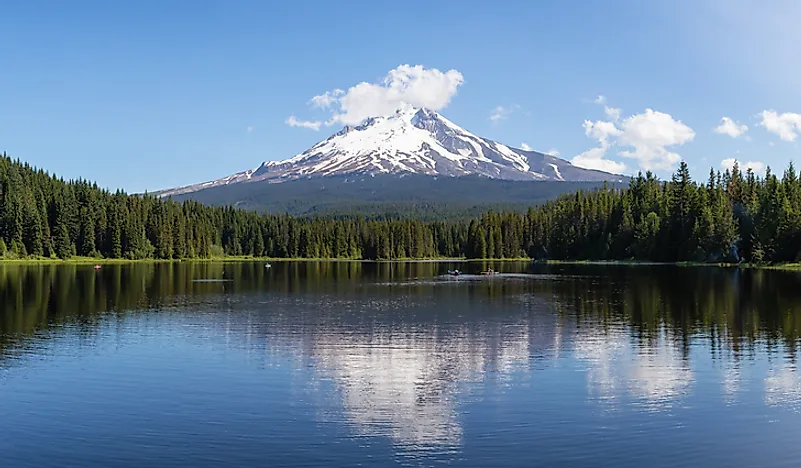
The view from Jonsrud Viewpoint on Bluff Road takes in Mount Hood over the Sandy River valley, with binoculars and Oregon Trail plaques on site. The river rises at Reid Glacier on the mountain and runs 55 miles. In 1846, Sam Barlow's toll road crossed it on the way west.
Sandy now has 1,664 residents aged 65 or more, compared with 1,197 in the earlier survey. Their newcomer share of 6.7% is about double the state rate, and 90% of those movers came from elsewhere in Oregon, against 49% statewide. The Sandy Community and Senior Center on Pioneer Boulevard hosts a Tuesday lunch for people 60 and over. Adventist Health Immediate Care in town is open every day, with lab and X-ray services on site.
Crooked River Ranch, Oregon

Since 1972, when it opened as a destination resort, Crooked River Ranch has grown into a subdivision of about 10,000 acres and more than 2,600 lots. Most of it lies in Jefferson County, with a smaller share in Deschutes County. Jefferson County's Medicare rolls grew 18.4% between 2020 and 2025, the second-fastest gain in the state and well ahead of the 11.6% statewide pace.
On the ranch itself, the older population rose from 1,488 to 1,682, and 7.0% of it arrived in the most recent survey year, roughly twice the statewide share. Nearly nine in 10 of those movers came from inside Oregon. Among households of all ages, Deschutes County leads Jefferson County's IRS inflows by a wide margin. The public Crooked River Ranch Golf Course, open since 1974, plays along the edge of the Crooked River Gorge. West of the ranch, a Bureau of Land Management trail of about half a mile leads to Steelhead Falls on the Deschutes River.
Canyonville, Oregon

The City of Canyonville calls itself the third-oldest settlement in Oregon. Early settlers ran a ferry across the South Umpqua River here, and Jesse Roberts platted the town site in 1858. Its older population grew from 590 to 676, while Douglas County's Medicare rolls rose 7.6%, below the 11.6% statewide.
Roughly one in 14 of those residents is a newcomer from the past year, about twice Oregon's rate. The newcomers split between Oregon and other states. For households of all ages, Lane, Coos, and Jackson counties lead Douglas County's IRS origins. Canyonville Health and Urgent Care on Pine Street stays open until midnight on weekdays. The Pioneer-Indian Museum, a South Umpqua Historical Society project, opened in 1982 with pioneer and Native American artifacts.
Vale, Oregon

Three Idaho counties top the IRS list of origins for households moving into Malheur County: Payette, Canyon, and Ada. Vale has served as the county seat since an 1888 election, on the Malheur River where Bully Creek joins it. Its population over 65 rose from 365 to 427.
About one in 13 is a recent arrival, more than double the state rate, and most crossed a state line to get there. Hot springs flow into the river from under Rinehart Butte. Their water has warmed town buildings for more than a century, including an indoor pool built in 1900. Dozens of outdoor murals retell the town's Oregon Trail history. The Rinehart Stone House, built of local sandstone in 1872, opens as a museum seasonally. Just outside town, the Keeney Pass Interpretive Site keeps wagon ruts of the original Oregon Trail along a short walking path.
Two Moves, One State
Oregon's older newcomers arrive by two routes at nearly equal volume, one from another Oregon county and one from another state. Jefferson and Washington counties posted two of the state's three fastest Medicare gains. Typical home values in September 2026 ran $605,496 in Clackamas County, $448,677 in Curry County, and $306,087 in Malheur County, against $492,753 statewide. Only Gold Beach and Newberg keep a hospital inside town, so the closest care in Warrenton, Sandy, and Canyonville is a clinic.


