A Brief Description

On his final voyage to the New World in 1502, Christopher Columbus came ashore on Costa Rica's Caribbean coastline (near Limon) and the indigenous Indians presented him with an offering of gold.

The lure of riches in the Americas was a strong magnet for European adventures of-the-day, but those that ventured to Costa Rica were confronted by an inhospitable landscape of coastal swamps and hostile Indians tribes - and most did not survive.

The Spanish persisted, and by the mid-16th century a few small settlements were successfully established; Cartago was declared the capital, and the colony was ruled by a governor appointed by the Spanish empire’s regional capital of Guatemala.

Unlike neighboring colonies, Costa Rica was slow to grow, and remained a collection of subsistence farmers for the next two centuries. With very few exports of real value, it quietly remained off the radar screen of the Spanish Crown.

After the overthrow of the Spanish King by Napoleon, Costa Rica and others declared their independence from Spain in 1821. Then, Costa Rica, as well as El Salvador, Guatemala, Honduras and Nicaragua formed the United Provinces of Central America, but that federation quickly dissolved, and Costa Rica became an independent state in 1838.

Juan Mora Fernandez (the first head of state) encouraged the cultivation of coffee, and over time the powerful coffee barons helped finance a political revolution that would change the country forever.

Over the next century an assortment of presidents and ambitious military dictators came and went, but for the most part, Costa Rica avoided the chaos of bloody coups, rebellions and citizen revolts endemic to other Central American countries.

In the mid-1900s, democracy was the order-of-the-day, but when the United Social Christian Party refused to leave power after losing the 1948 general election, civil war was in the wind.

The opposition in that brief 40-day uprising was led by Jose Mar¡a (Don Pepe) Figueres Ferrerhe, and in the end he founded a new republic; banned the Communist Party; women could vote; blacks gained citizenship; and in a brilliant stroke of governing he abolished the armed forces (what a concept) and established a term limit for all future presidents.

When Don Pepe died in 1990 (a justifiable national hero to this day) his innovative leadership had earned Costa Rica an enviable international reputation as a peaceful, stable democracy in a region of instability.

Today, driven by agricultural products (especially coffee), and strong tourism and technology industries, Costa Rica enjoys a high standard of living, and remains the true success story of Central America.

Read more about Costa Rica here.

Coffee is King in Costa Rica
Travel the World through Poster Art!
Facts and Figures

Name Costa Rica

(long form) Republic of Costa Rica

Population 4,016,200

Population & Density (all countries) here

Capital City San Jose (300,000)

Currency Costa Rican Colon (CRC)

Currency Converter
here

Languages Spanish (official), English

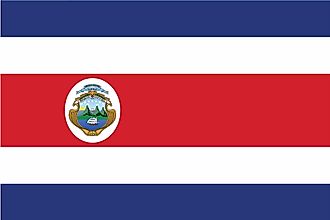
Flag here

National Day September 15

Religions Catholic (76.3%), Evangelical (13.7%), none (3.2%), others

Geographic Coordinates

Latitude/Longitude (Capital City)
9º 56' N, 84º 05' W

Relative Location
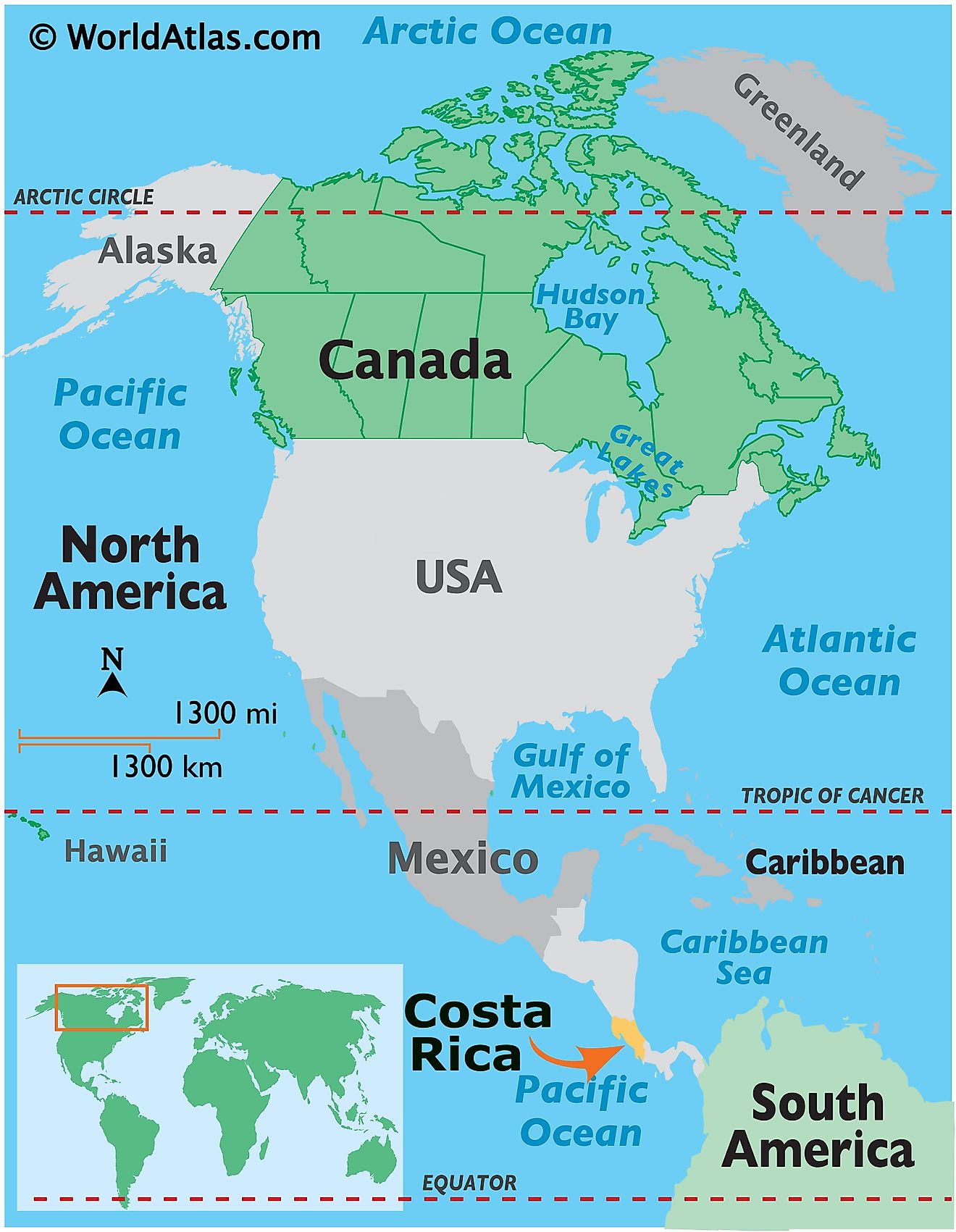
Costa Rica is positioned in both the northern and western hemispheres.
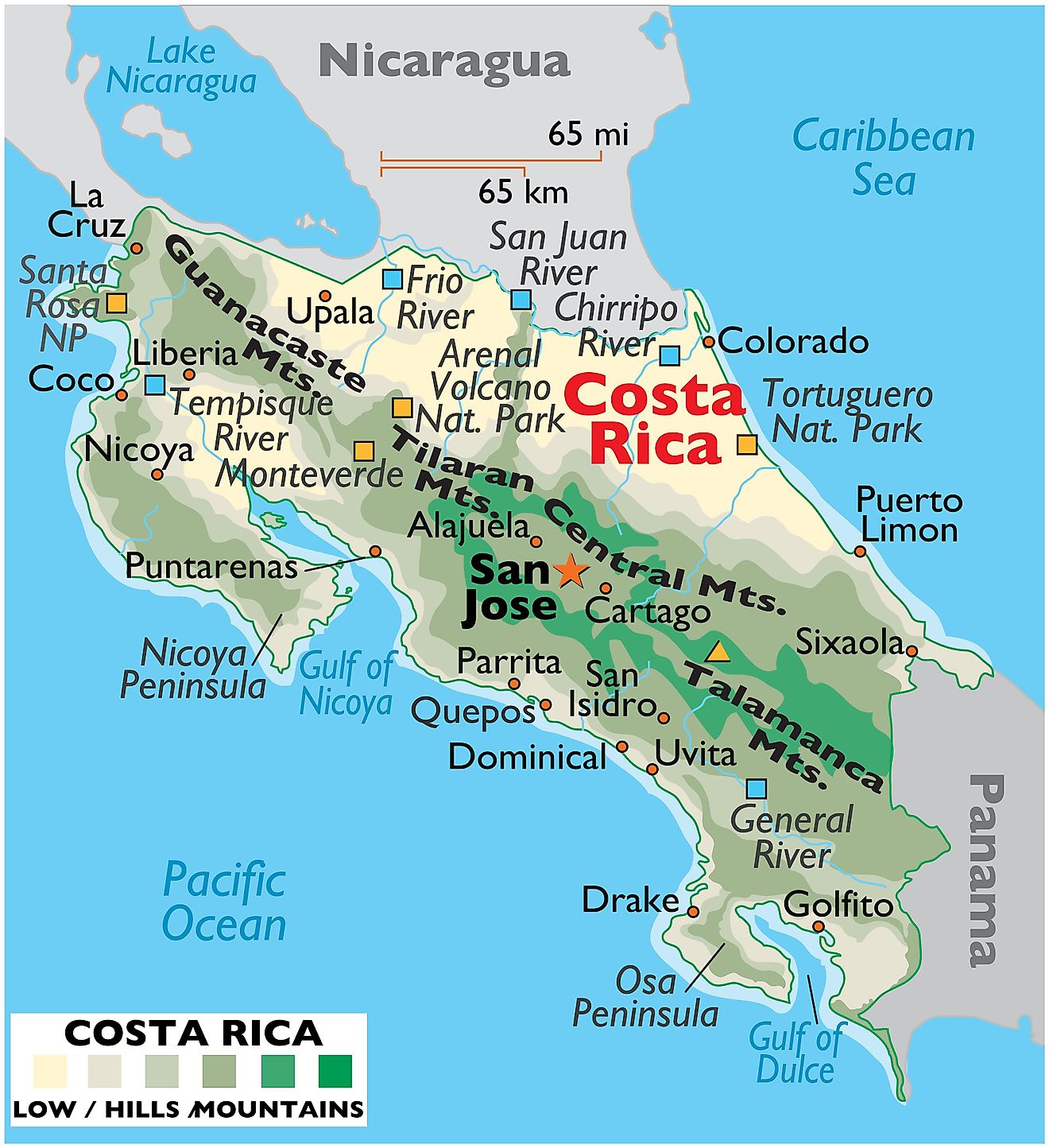
Located in North America on the Central America isthmus - a somewhat narrow strip of land that connects North and South America - the country is bordered by Nicaragua, Panama, the Pacific Ocean and the Caribbean Sea.

Land Statistics

Coastline 802 miles (1,290 km)

Land Areas

(land) 19,560 sq miles (50,660 sq km)

(water) 170 sq miles (440 sq km)

(TOTAL) 19,730 sq miles (51,100 sq km)

Land Area (all countries) here

Landforms
Most of Costa Rica is dominated by the Sierra Madre mountains, literally fractured into individual ranges and valleys by violent volcanic eruptions over eons of time.

And speaking of volcanoes, the country's most active one (cone-shaped Arenal), located in the Tilaran Mountains erupts in some measure almost everyday. To the southeast, the Poas, Barva, Irazu and many other volcanoes form the Central Mountain's most spectacular landforms, while the higher Talamanca Mountains front its southern border with Panama.

The heavily-forested northern plains (to the south of Lake Nicaragua) stretch eastward along the San Juan River, then push southward through the rain forest edges of the Central Mountains, and on to the sandy beaches of the Caribbean coastline.

Costa Rica's beach-covered Pacific coastline is quite narrow, and indented with many small bays, as well as the Gulf of Dulce and the Gulf of Nicaya, both protected by hook-shaped peninsulas. In the west, those beaches rise abruptly into the coastal hills of the mountains.

Many dozens of rivers drain the land; the Chirripa, Frio, General, San Juan and Tempisque are indicated on the map above.

Highest Pt. Cerro Chirripo - 12,500 ft. (3,810 m)

Lowest Pt. Pacific Ocean - 0 ft. (0 m)

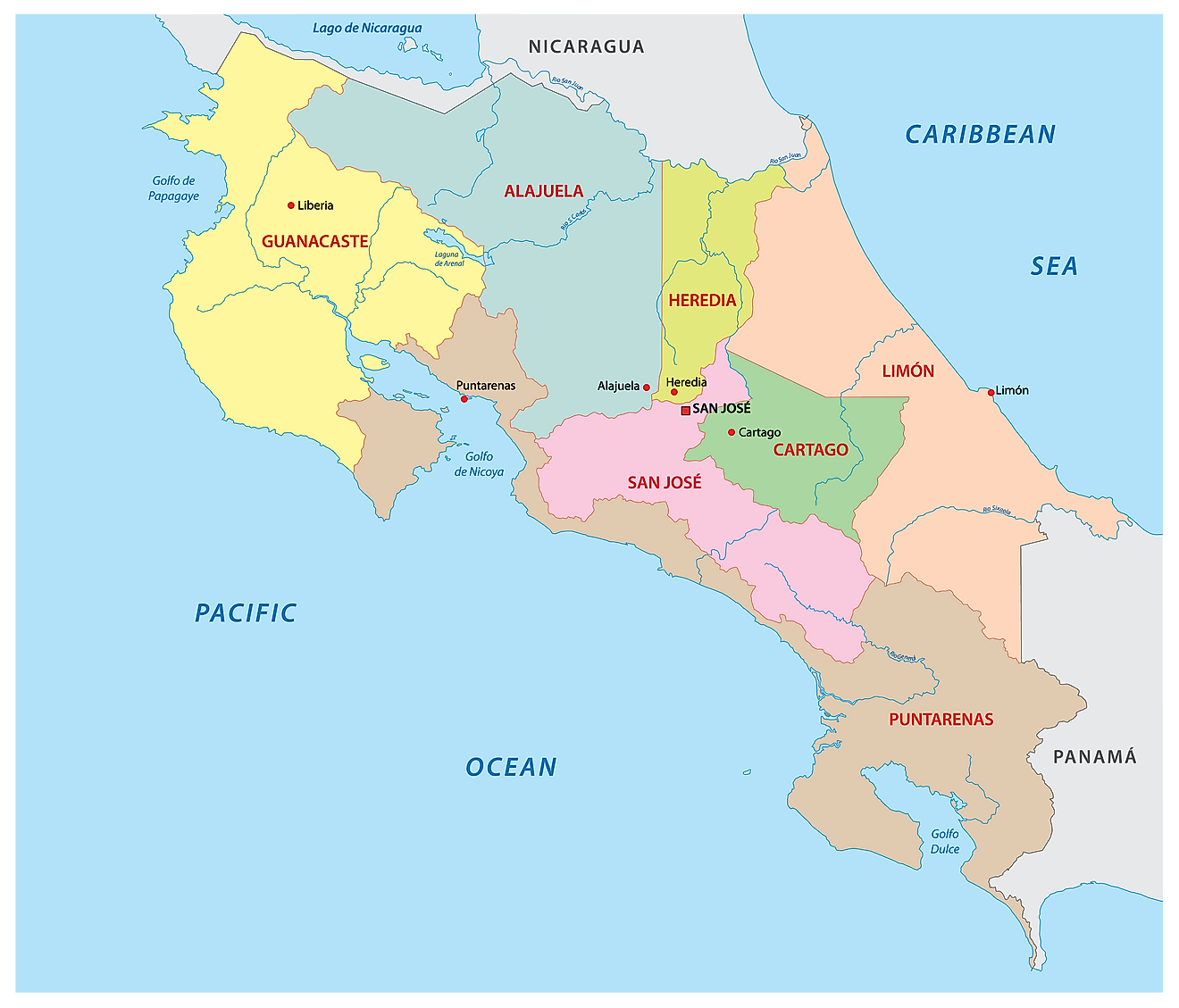
Land Divisions 7 provinces; including Alajuela, Cartago, Guanacaste, Heredia, Limon, Puntarenas and San Jose.


Contact Us | Privacy Statement

Copyrighted by Graphic Maps
All rights reserved!

All maps, graphics, flags and original descriptions created by Graphic Maps, a d/b/a of the Woolwine-Moen Group, unless otherwise noted and/or directly linked to the source, and use of same for any application whatsoever (with the exception of outline maps) requires written permission.

We make no copyright claim on any statistical data on this page, nor on any non-original graphics, and/or pictures not produced by us. Certain statistical data is gathered from the CIA World Factbook, as well as numerous public domain reference materials.

Every effort is made to be as accurate as possible when disseminating information on any worldwide destination. We are not responsible for unintentional data entry errors or omissions. If you would like to submit an addition, change or correction, or suggest a new link, please forward it to our map department and we will give it our immediate attention.

|
|
Maps

Costa Rica (large color) Map here

Costa Rica Outline Map here

Costa Rica CIA version here

Costa Rica Maps at UT here

Ring of Fire map here!

- - - - - - - - - - - - - - - - - - - - - - - - - - - - -

Central America (Capital Cities)
here!

Central America (Maps at UT)
here!

Central America (Outline)
here!

Central America (Volcanoes)
here!

Panama Canal here!

- - - - - - - - - - - - - - - - - - - - - - - - - - - - -

North America (Capital Cities)
here!

North America (Lakes)
here!

North America (Landforms)
here!

North America (Outline)
here!

North America (Rivers)
here!

North America (Country Test) here!

- - - - - - - - - - - - - - - - - - - -

World Outline Maps (printable) here

World Time Zone Map here


Recommended Links

Costa Rica (Complete) info on the (GDP)
economy, imports and exports, natural resources, government, population, military, transportation, and more here

Costa Rica Embassy (Washington, DC) here

Costa Rica Photos at TrekEarth.com here

Costa Rica Tourism here

Welcome to Costa Rica here

Time and Weather


Climate
Costa Rica's tropical climate is pleasant throughout the year, with prevailing trade winds helping to cool down much of the coastal areas.

March through May are the hottest months, while somewhat cooler temperatures are the norm, December, January and February.

As usual in mountainous countries, temperatures vary by elevation. In Costa Rica, the average high temperature in the elevated Central Valley (I.E. San Jose) is near 72° F; in the lows 80s along the Caribbean coastline, and approaching 90° F on the Pacific coast.

The country receives copious amounts of rain, with an annual yearly average near 100 inches (250cm). The heaviest amounts fall along the Caribbean coastline in the form of afternoon showers.


Arenal Volcano, Costa Rica
Travel the World through Poster Art!

a stunning photo of the Arenal Volcano
is here!

Traveler Info

Attractions:
Of all of the vacation destinations on the planet, Costa Rica is certainly one the most exotic, as it offers unparalleled natural beauty, fiery volcanoes, misty cloud forests, thick jungle rain forests, and a wide range of national parks and eco-tourism activities.

In addition, Costa Rica has over 1,000 miles of simply gorgeous white-and-black sand beaches, plenty of sunshine, and more than its share of world-class sport fishing, snorkeling and surfing venues.

The most popular nature attractions include a litany of volcanoes, including Arenal Volcano, that almost-daily produces a spectacular show of lava, rock and stream; the active (and viewable) crater in the Poas Volcano; summit tours of the stunning Irazus Volcano; Monteverde Cloud Forest Reserve; Osa Peninsula and the Corcovado National Park, and the Caribbean flora and fauna of the Tortuguero National Park.

The single most-visited place in Costa Rica is the capital city of San Jose; it serves as the main entry point into the country, and its mixture of traditional Spanish architecture, museums and theaters are first rate. Limon, on the Caribbean coastline, hosts cruise ships from around the world and some fabulous markets and shops along its seawall.

Of all of the countries in Central America, Costa Rica has historically been the friendliest and safest.

Costa Rica Hotels, Tours and Travel Information

Country Dialing Code 506

Electricity Costa Rica uses 220 volts AC (60 HZ)

Electrical adapters, products and tips here

Travel Warnings
here

Visa Information
here

PLEASE
NOTE:
Before making travel plans for any worldwide destination, we strongly recommend you authenticate important details regarding visas, local health care, customs, etc. We always find it helpful to contact the nearest consulate of any country before beginning a journey into a foreign land.

|
|
Central America
Countries

Belize

Costa Rica

El Salvador

Guatemala

Honduras

Nicaragua

Panama

NORTH AMERICA
COUNTRIES


Antigua
and Tobago

Bahamas

Barbados

Belize

Canada

Costa Rica

Cuba

Dominica

Dominican Rep.

El Salvador

Grenada

Guatemala

Haiti

Honduras

Jamaica

Mexico

Nicaragua

Panama

St. Kitts & Nevis

St. Lucia

St. Vincent and
the Grenadines

Trindad
and Tobago

United States

A colorful tree frog, Costa Rica
Travel the World through Poster Art!

Central America
Countries


Belize

Costa Rica

El Salvador

Guatemala

Honduras

Nicaragua

Panama

NORTH AMERICA
COUNTRIES


Antigua
and Tobago

Bahamas

Barbados

Belize

Canada

Costa Rica

Cuba

Dominica

Dominican Rep.

El Salvador

Grenada

Guatemala

Haiti

Honduras

Jamaica

Mexico

Nicaragua

Panama

St. Kitts & Nevis

St. Lucia

St. Vincent and
the Grenadines

Trindad
and Tobago

United States

Central America
Countries


Belize

Costa Rica

El Salvador

Guatemala

Honduras

Nicaragua

Panama

|