Maps of West Virginia
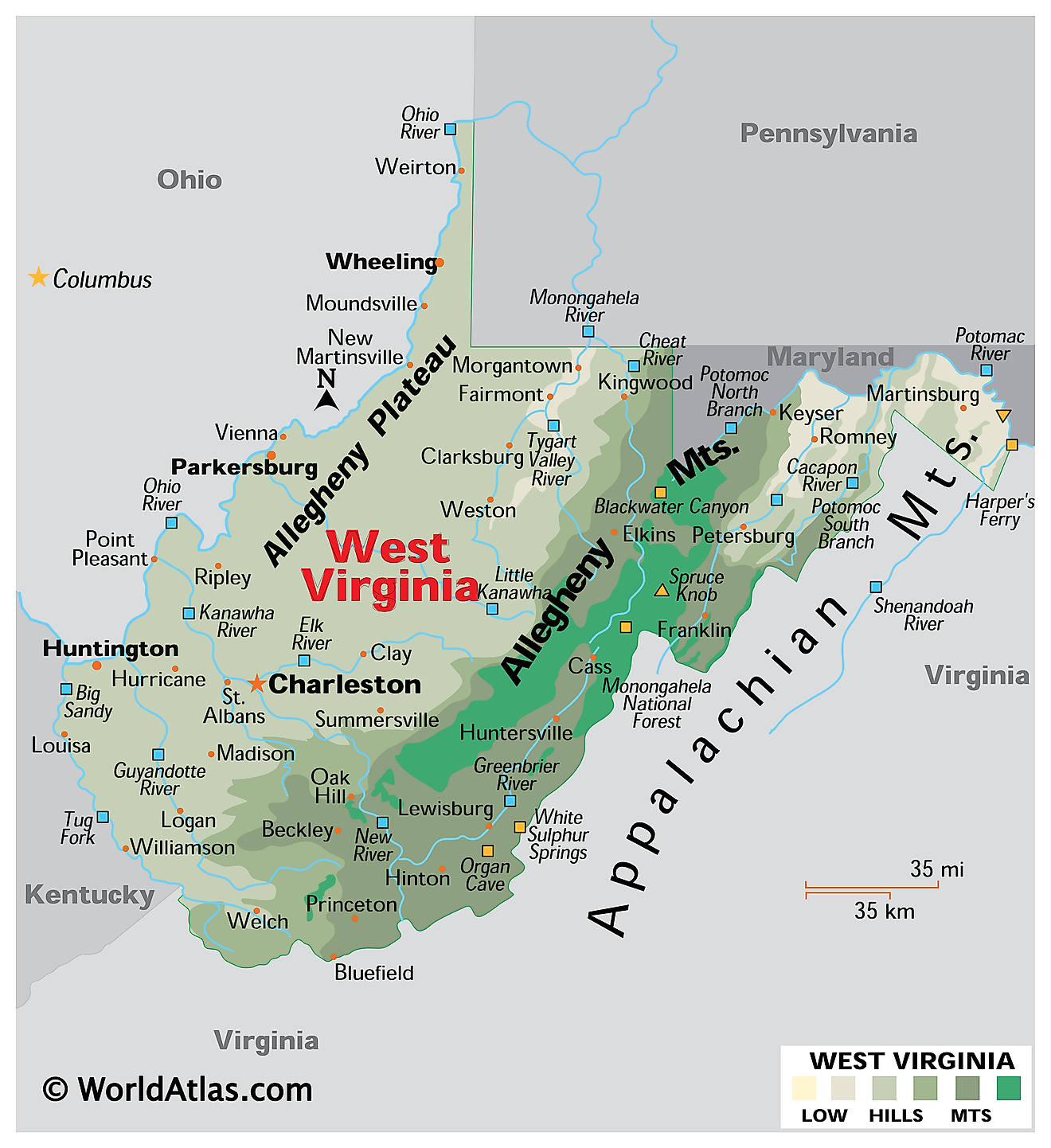
West Virginia is a state in the Appalachian region of the eastern United States, classified by the Census Bureau within the South Atlantic division. It shares its borders with Virginia to the southeast, Kentucky to the southwest, Ohio to the northwest, Pennsylvania to the north, and Maryland to the northeast. The state encompasses a total area of 24,230 square miles (62,755 square kilometers), making it the 41st largest US state.

West Virginia is the only state lying entirely within the Appalachian Mountains, and the nickname "the Mountain State" is more than a slogan. Its mean elevation of about 1,500 feet is the highest of any state east of the Mississippi River, and there is almost no flat ground anywhere in it. What look like mountains here are mostly not folded peaks but a high plateau that rivers have carved into a maze of ridges, knobs, and narrow hollows — an inverted landscape, cut down rather than pushed up.
Where Is West Virginia?
West Virginia has one of the most irregular outlines of any state, a consequence of following rivers and mountain crests rather than survey lines. Two panhandles reach far out from the main body: the Northern Panhandle runs up between Ohio and Pennsylvania to within 40 miles of Lake Erie, and the Eastern Panhandle extends toward Washington, D.C. The result is a state whose northernmost point sits further north than Pittsburgh and whose southernmost lies at the latitude of Richmond.
With roughly 1.77 million residents, West Virginia is among the less populous states, and it is divided into 55 counties. Its western boundary is the Ohio River, and unusually, the state's jurisdiction extends to the low-water mark on the Ohio bank rather than to the middle of the channel.
The Appalachian Plateau

The Appalachian Plateau, also called the Allegheny Plateau, covers the western two-thirds of West Virginia — by far the largest of the state's regions. Its rocks are flat-lying to gently folded sedimentary layers, and they hold the coal and natural gas that shaped the state's economy.
Structurally this is a plateau, but it does not look like one. Streams have dissected it so thoroughly that almost nothing of the original upland surface remains level; the ridgetops simply mark where that surface used to be. Elevations climb steadily eastward, from about 600 feet along the Ohio River to over 4,800 feet at the plateau's eastern rim.

That rim is the northeastern corner of the province, known as the Allegheny Mountain section or Allegheny Highlands, and it contains the state's high country. Spruce Knob, on Spruce Mountain in Pendleton County, is the highest point in West Virginia at 4,863 feet (1,482 meters) — and it lies here, in the Allegheny Mountains, not in the Blue Ridge. It is also the highest point in the entire Allegheny range. Its wind-scoured summit carries red spruce flagged into one-sided shapes by the prevailing westerlies.

The plateau's eastern edge is the Allegheny Front, a dramatic escarpment dropping as much as 3,000 feet into the Valley and Ridge below. It is also a sharp climatic divide: air rising over the Front dumps its moisture on the west side, leaving a pronounced rain shadow to the east. The high country behind it holds Dolly Sods, Canaan Valley, and Blackwater Falls, where the tannin-stained Blackwater River drops 57 feet before entering an eight-mile canyon.
The Valley and Ridge

East of the Allegheny Front lies the Valley and Ridge, covering roughly a fifth of the state across five whole counties and parts of seven more. Here the sedimentary rock was not merely warped but tightly folded and faulted during the collision that built the Appalachians some 300 million years ago. Erosion since then has stripped away the softer shale and limestone, leaving resistant sandstone standing as long, narrow, parallel ridges separated by farmed valleys.
Seneca Rocks is the region's signature landmark: a fin of Tuscarora quartzite standing nearly 900 feet above the North Fork valley, tilted almost vertical by that ancient folding. The limestone valleys are riddled with caves and sinkholes, and Greenbrier and Pocahontas counties hold some of the most extensive cave systems in the eastern United States.

At the far eastern edge, in the Eastern Panhandle, the ridges give way to the Great Valley — the same broad limestone trough that runs south as Virginia's Shenandoah Valley. Its deep, fertile soils make Berkeley and Jefferson counties the most productive farmland in the state, and the flattest ground West Virginia has.
The Blue Ridge

West Virginia does contain a fragment of the Blue Ridge Province, but it is very small — limited outcrops at the extreme eastern tip of the state, near Harpers Ferry in Jefferson County. The West Virginia Geological and Economic Survey describes it as "a very small portion of a third province," noting that Blue Ridge rocks are far better exposed across the line in Virginia.
What distinguishes it is the rock: ancient late-Precambrian metavolcanic material of the Catoctin Formation, crystalline and roughly a billion years old, entirely unlike the sedimentary layers that make up the rest of the state. At Harpers Ferry the Potomac and Shenandoah rivers meet and cut together through the Blue Ridge in a water gap — a view Thomas Jefferson called worth a voyage across the Atlantic.
Rivers

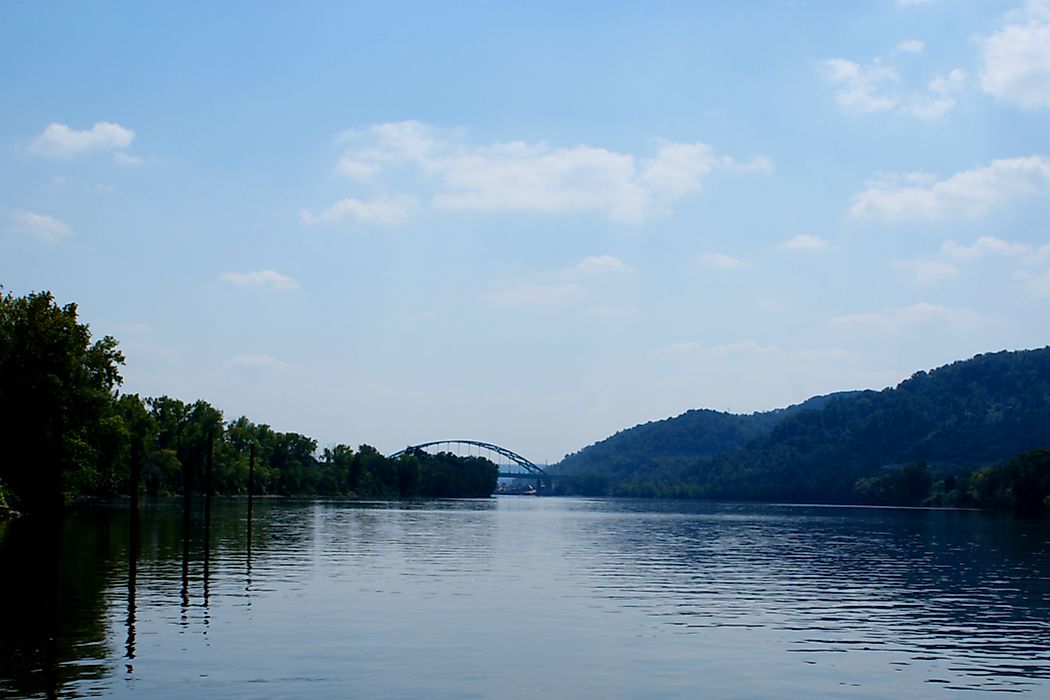
Because West Virginia is so high and so steep, it is a source region rather than a through-route: most of its rivers begin within the state. Drainage splits along the Allegheny Front. Everything west flows to the Ohio and eventually the Mississippi; everything east of the Front drains to the Potomac and the Chesapeake.
The New River is the most remarkable. Despite its name it is one of the oldest rivers on the continent — old enough that it already existed when the Appalachians rose around it, and it cut downward to hold its course rather than diverting. It is also one of the few major rivers in North America that flows north. Below Fayetteville it has carved the New River Gorge, up to 1,000 feet deep, which became a national park in 2020.

The Kanawha, formed where the New meets the Gauley, is the state's principal waterway and its industrial corridor. The Monongahela is one of the few American rivers that flows north for its entire length, running from the Cheat and Tygart Valley rivers up into Pennsylvania to help form the Ohio at Pittsburgh. Others include the Greenbrier, the Elk, the Guyandotte, the Little Kanawha, and the Big Sandy, which forms part of the Kentucky border.
Lakes and Reservoirs

West Virginia has no natural lakes of any size. The terrain is too steep and too well drained to hold standing water, and the last continental ice sheet stopped well to the north, so the state was never given the glacial basins that dot New England and the upper Midwest. Every significant lake here is a reservoir behind a flood-control or hydroelectric dam.
Summersville Lake, on the Gauley River in Nicholas County, is the largest at about 2,790 acres. Built by the Army Corps of Engineers in 1966, it is known for exceptionally clear water — a consequence of its sandstone basin, which yields little suspended sediment. Its autumn drawdown produces the controlled releases that make the Gauley one of the premier whitewater rivers in the country.

Other major impoundments include Cheat Lake near Morgantown, Bluestone Lake on the New River, Tygart Lake, Stonewall Jackson Lake, and Sutton Lake. Spruce Knob Lake, high in the Monongahela National Forest, sits at over 3,800 feet.
Forests and Land Cover

Roughly 79% of West Virginia is forested — the third highest proportion of any state, behind only Maine and New Hampshire. Most of it is second-growth mixed mesophytic hardwood, among the most species-rich temperate forest types in the world, with oak, maple, hickory, black cherry, and tulip poplar.
Elevation drives the variation. Above about 3,000 feet in the Allegheny Highlands, red spruce and balsam fir take over — a boreal forest type more typical of Canada, stranded here since the last Ice Age. The Cranberry Glades, at 3,400 feet, hold genuine sphagnum bogs with cranberries, sundews, and other plants otherwise found hundreds of miles north. The Monongahela National Forest protects over 900,000 acres of this high country.
Climate

West Virginia has a humid subtropical climate in the lower western valleys and a humid continental climate through the mountains, with elevation mattering far more than latitude. The Ohio Valley around Huntington averages close to 55 °F annually; the high Alleghenies run more than 10 degrees colder, and Canaan Valley at 3,200 feet has a growing season of barely 100 days.
Precipitation is heavily controlled by the Allegheny Front. West-facing slopes receive 55 to 60 inches a year, while the Eastern Panhandle, in the rain shadow, gets as little as 32 inches — the driest part of the state. Snowfall follows the same pattern: under 30 inches in the southwest but over 180 inches in the highest Alleghenies, where enough falls to support ski areas at Snowshoe and Canaan Valley. Flash flooding is the state's chief hazard, since steep, narrow valleys concentrate runoff quickly.
West Virginia Geography at a Glance
| Feature | Detail |
|---|---|
| Total area | 24,230 sq mi (62,755 sq km) — 41st largest state |
| Highest point | Spruce Knob, 4,863 ft (1,482 m), Pendleton County — Allegheny Mountains |
| Lowest point | Potomac River at Harpers Ferry, approx. 240 ft |
| Mean elevation | Approx. 1,500 ft — highest of any state east of the Mississippi |
| Bordering states | Five: Virginia, Kentucky, Ohio, Pennsylvania, Maryland |
| Physiographic provinces | Appalachian Plateau (western two-thirds), Valley and Ridge (eastern third), plus a small Blue Ridge fragment near Harpers Ferry |
| Western boundary | Ohio River |
| Forest cover | Approx. 79% — third highest of any state |
| Largest lake | Summersville Lake, approx. 2,790 acres (reservoir) |
| Natural lakes | None of significant size |
| Counties | 55 |
Counties Map
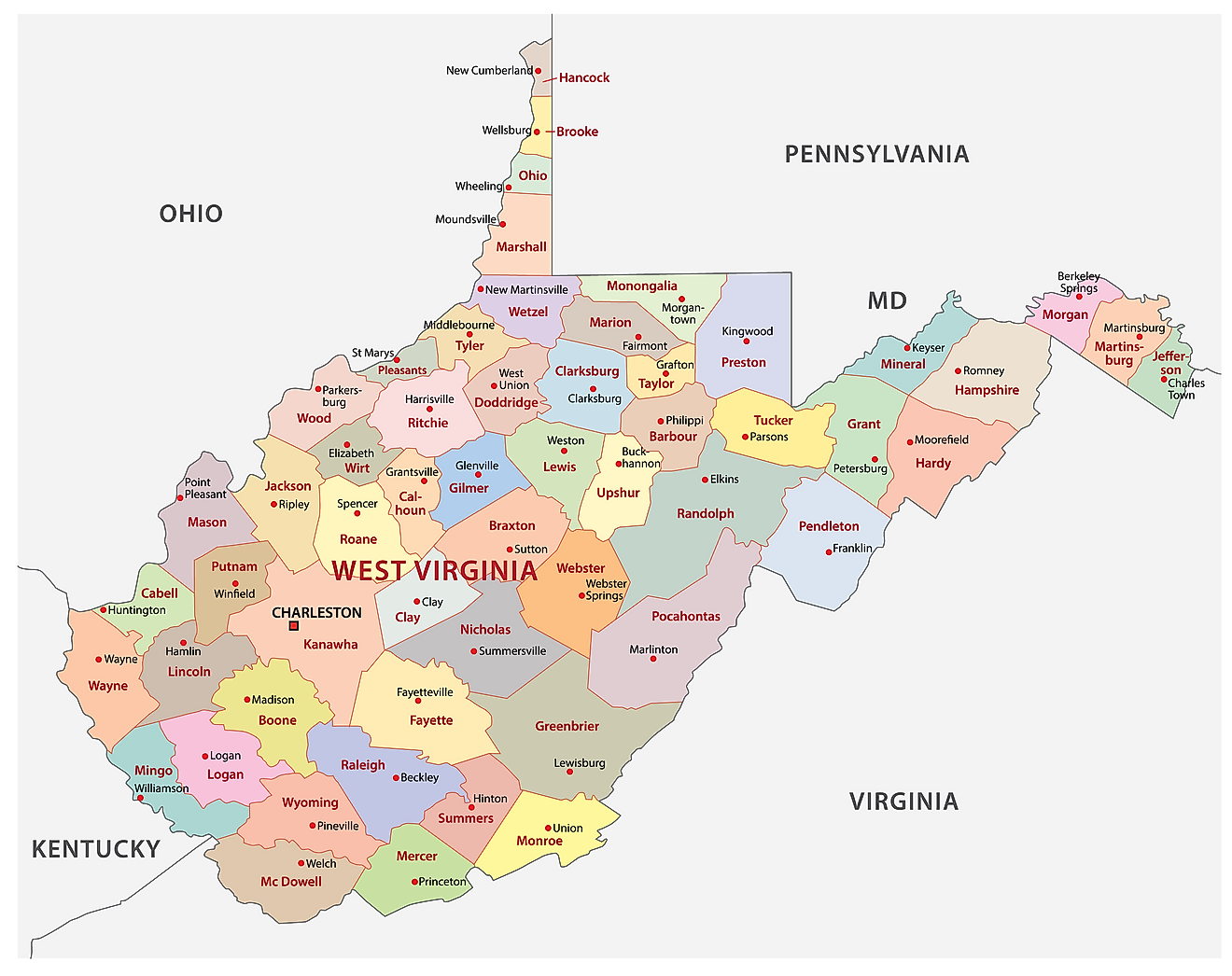
The State of West Virginia is divided into 55 counties. In alphabetical order, these counties are: Barbour, Berkeley, Boone, Braxton, Brooke, Cabell, Calhoun, Clay, Doddridge, Fayette, Gilmer, Grant, Greenbrier, Hampshire, Hancock, Hardy, Harrison, Jackson, Jefferson, Kanawha, Lewis, Lincoln, Logan, Marion, Marshall, Mason, McDowell, Mercer, Mineral, Mingo, Monongalia, Monroe, Morgan, Nicholas, Ohio, Pendleton, Pleasants, Pocahontas, Preston, Putnam, Raleigh, Randolph, Ritchie, Roane, Summers, Taylor, Tucker, Tyler, Upshur, Wayne, Webster, Wetzel, Wirt, Wood, and Wyoming.
With an area of 62,754.8 sq. km, West Virginia is the 41st largest and the 39th most populous state in the USA. Located in the west-central part of the state, at the confluence of the Elk and Kanawha Rivers in the Kanawha Valley of the Allegheny Plateau, is Charleston – the capital and most populous city of West Virginia. It serves as an administrative, cultural, economic, and industrial center for the state.
Where is West Virginia?
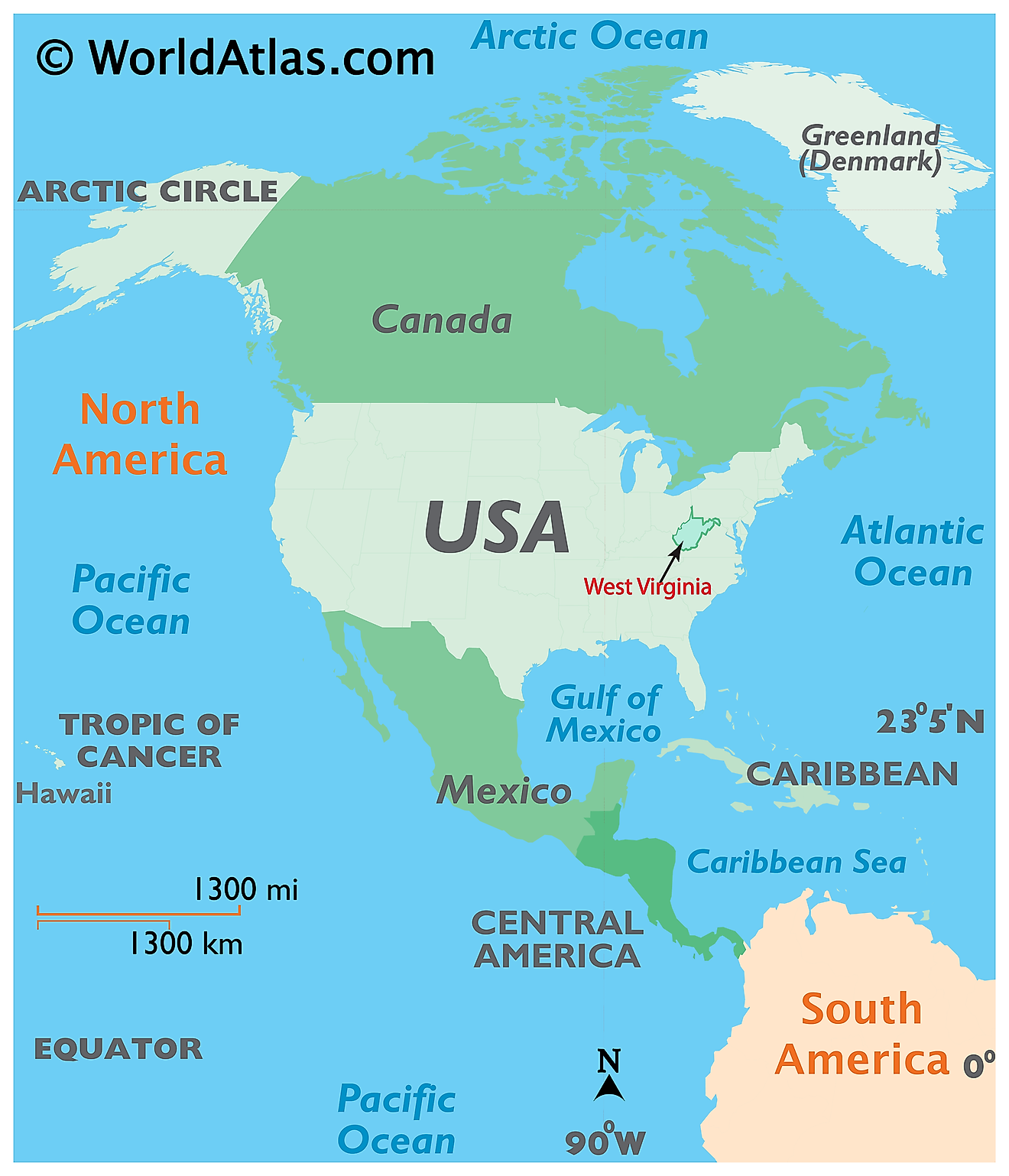
The State of West Virginia is located in the South Atlantic Region of the United States. West Virginia is landlocked and shares its land borders with 5 states. It is bordered by Virginia in the southeast; by Kentucky in the southwest; by Ohio in the northwest; by Pennsylvania in the northeast and by Maryland in the east and northeast.
Regional Maps: Map of North America
Outline Map of West Virginia
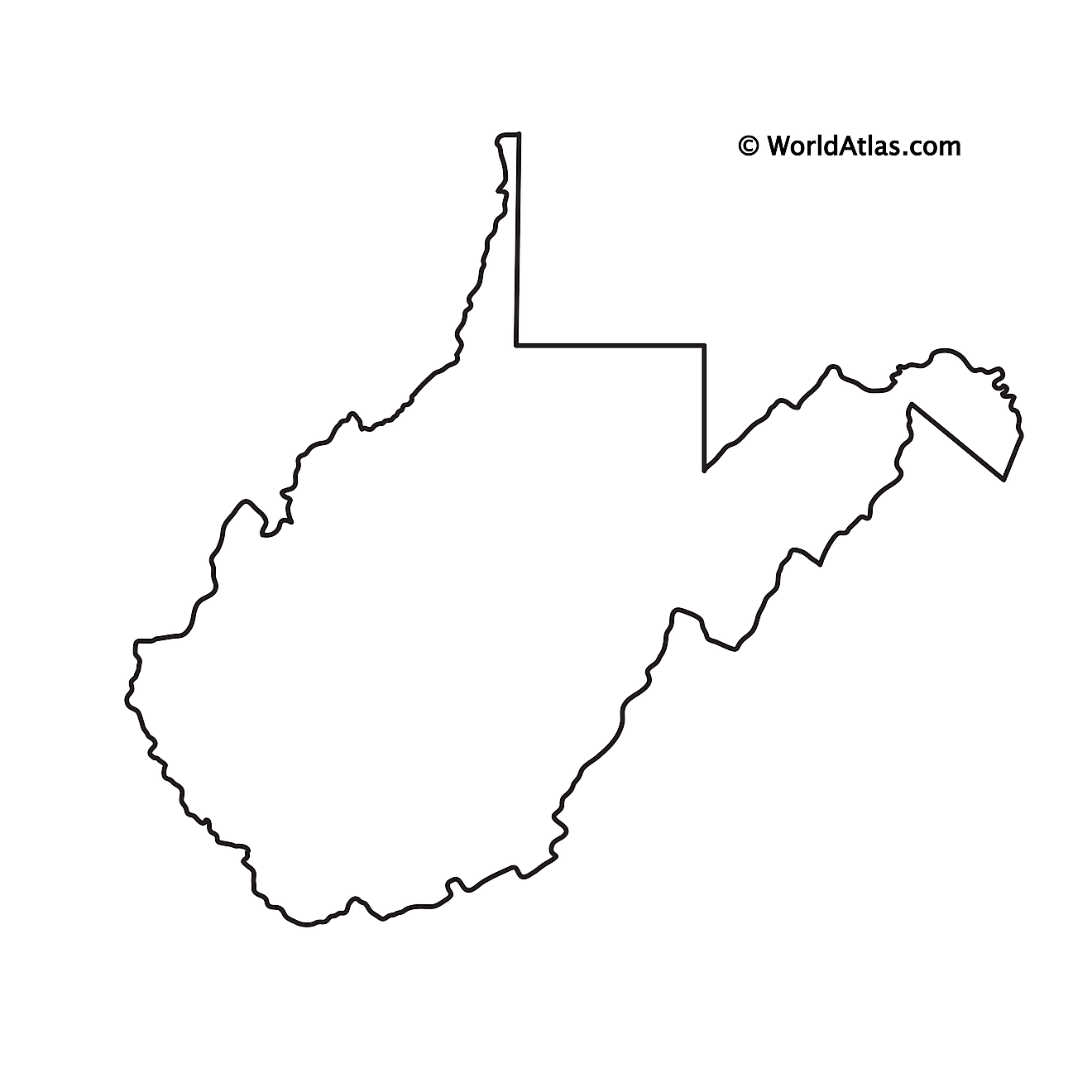
The above blank map represents the State of West Virginia, located in the South Atlantic Region of the United States. The above map can be downloaded, printed and used for geography education purposes like map-pointing and coloring activities.
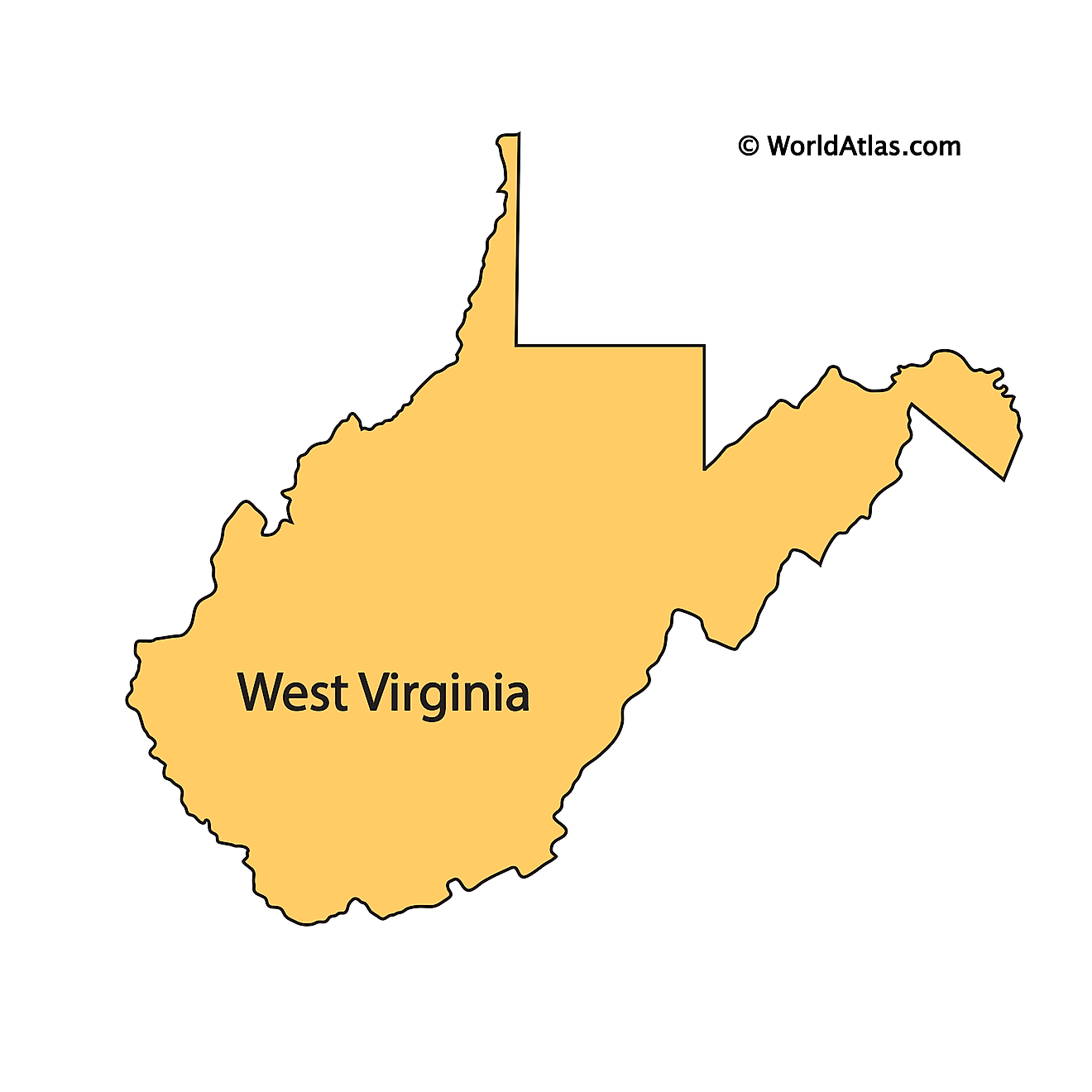
The above outline map represents the State of West Virginia, located in the South Atlantic Region of the United States. It has been nicknamed as "Mountain State" due to its location at an elevation of 1,500ft (460m), which is the highest among all states of the nation, that are situated to the east of the Mississippi River.
Key Facts
| Legal Name | State of West Virginia |
|---|---|
| ISO 3166 Code | US-WV |
| Capital City | Charleston |
This page was last updated on September 17, 2026


