
Where Black Widows And Brown Recluses Overlap
No one wants to hear, "I think I saw a black widow on the house!" or "I got bit by a brown recluse!" After all, these spiders have enough venom to harm humans, and their territory is more widespread than one might think.
Unfortunately for those afraid of spiders, if one lives in a place with brown recluses, there are black widows around as well. Their territory overlaps completely with the smaller territory of brown recluses. Below we will discuss their behavior, characteristics, and some information about the different types of venom these spiders possess.
The black widow's many relatives

The black widow is by no means alone out there in the world, she (or he) has several relatives, which explains its wide geographical range. There are five in particular: northern, southern, western, red, and brown.
Northern and southern black widows divide the eastern U.S. between them. The southern black widow is considered the most iconic of the species, with its hourglass figure, while the northern one can have several red markings that are split. Western black widows are similar in appearance to southerners, although their hourglass shape can be orange.
Only females possess the hourglass shape, and they tend to be larger than males, with females growing to half an inch and males about a quarter of an inch. Males have spots on their bodies rather than hourglasses.
The red widow spider is a rare related widow species today, only found in scrublands in Florida, where development has shrunk its habitat.
The brown widow, meanwhile, is an invasive species that originated in Africa and was first recorded in Florida in 1935, and found in southern California by 2003. It l has an orange or yellow-orange hourglass rather than a red one. It also tends to build its webs in buckets, under vehicles, or underneath furniture, and does not hide in as secluded of spaces as other black widows. It is considered an invasive species as it is outcompeting the southern black widow for space and resources.
Native black widow species are found across the lower 48 states, with the western black widow covering the West. One possible explanation for this spread is global climate change making weather better suited for this spider.
The weather is important for black widows, as they tend to stay outdoors or on exterior surfaces of buildings, such as in crawl spaces, rocks, or in older sheds.
Does it deserve its femme fatale reputation?

The term black widow has been applied to superheroes and female assassins due to how black widow spiders behave during mating. Many believe that black widows always trap and eat their mates after copulation, but this isn't always the case.
For one, this behavior was often seen in experiments where the male had nowhere to run. In addition, occasionally the southern black widow has been shown to eat their mates in the wild, while the western and northern do not.
Males also know to "test the web" first before they approach females to mate. First, they will examine the web to make sure it is a black widow's web. As he approaches, he checks chemicals in her web to see if she has eaten recently or is still hungry and likely to turn him into her next meal. Where cannibalism truly happens is after the female's eggs hatch, as the baby spiders will begin eating each other immediately, and only a small group of the average of 250 eggs will survive to adulthood.
The brown recluse
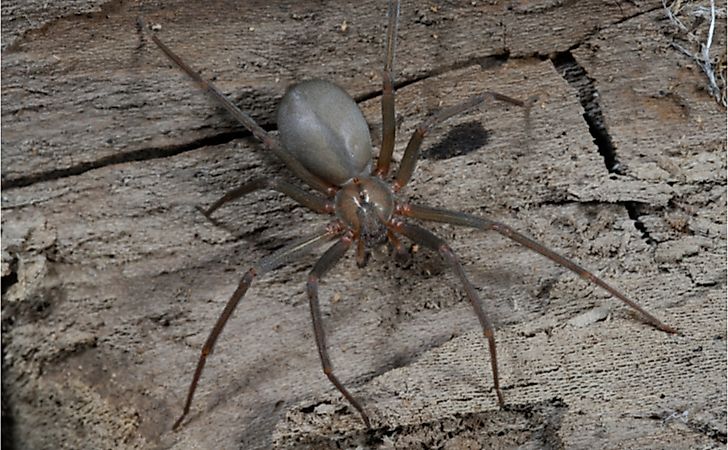
The brown recluse has a far more restricted range than the many relatives of black widows. Its range does not extend very far north. It can be found in Texas, Oklahoma, southeastern Nebraska, southern Iowa, Missouri, Arkansas, Louisiana, Illinois, Indiana, Kentucky, Tennessee, Alabama, Mississippi, Georgia, Kansas, and scattered, localized populations in Florida.
The main reason for this restricted range is that it cannot survive freezing temperatures, with some research showing they die off at temperatures lower than 23 degrees fahrenheit. Commonly, they are only active in ranges from 45 to 110 degrees Fahrenheit. Much like the black widow, it has an identifiable marking, but instead of an hourglass, it has a violin marking on its head and thorax. True to its name, it's mainly brown and tan.
It primarily prefers dry areas in caves or log piles, and is known to sneak in through crawl spaces or cracks. The reason for the recluse name is that they remain hidden during the day and come out at night to hunt.
Male brown recluses use fine hairs on their body combined with chemical detection to find a mate. Like black widows, they announce their presence prior to approaching their mate so she doesn't accidentally mistake him for prey and eat him.
How dangerous is their venom?

Brown recluse spider venom is both cytotoxic and hemotoxic, meaning it destroys tissue and harms the bloodstream. With brown recluses, they will flee when approached by humans and only bite when a human rolls over on top of them or attempts to crush them.
Symptoms of a brown recluse bite appear slowly, beginning first with two small puncture spots, followed by redness and blisters. Depending on the severity of the bite, it can take several weeks to heal. Clinical studies have shown that in adults, symptoms include nausea, headache, and general drowsiness, while in children, symptoms can be as severe as fever, seizures, organ failure, and even death.
Black widow spider bites are also defensive, either by someone running into the spider or by a mother spider who is trying to defend eggs. Male spiders do not have long enough fangs to break the skin; only females will bite. Their venom profile is different from brown recluses, consisting of neurotoxins that are known as latrotoxins.
This venom is made of seven individual toxins that interrupt transmission of signals to the nervous system via presynaptic membranes. This is part of why these bites cause such severe pain and muscle spasms. Some of the symptoms include difficult breathing, chest pain, nausea, sweating, fevers, and swollen eyes. Skin color can also change into a blue-ish gray color, and at times victims may develop a skin infection called cellulitis.
Do people die from their bites?

The answer is mostly no. In the case of black widow bites, there has been no recorded deaths from a black widow in recent history, with one study of more than 15,000 bites showing no deaths and only 10% ending up with a hospital admission. In many cases, bites can be treated by regular cleaning and pain relief.
For brown recluse spiders, deaths are very rare, with only a handful of deaths reported, mainly in children. One reason behind this higher number may be that brown recluses are more commonly found in homes, thus putting children at more risk of being bitten than with black widows. In fact, some homes can wind up with large infestations of brown recluses and might not even know it due to their hidden nature.
In either case, treatment for both bites are mostly the same: water and soap to keep the wound clean and pain medicine as needed. Anyone who is bitten by a spider, especially children, should seek medical attention in case extra care is needed, such as antivenom for black widow bites.


